
Starling
Sturnus vulgaris

How to describe the song of a starling?
Ornithologist Bernard Tucker called it:
“a lively rambling medley of throaty warbling, chirping, clicking, and gurgling sounds, interspersed with musical whistles and pervaded by a peculiar creaking quality”
You might think of it as a bag full of random clockwork pieces, all whirring, wheezing and clicking.
And that's just the start of it, because starlings are excellent mimics. They can do a telephone ring, a human voice, a vehicle noise, and pretty much anything else.
‘I ran indoors but there was no-one calling.’
‘Why is someone whistling from our roof?’
‘Is that an ASDA truck reversing onto our front lawn?’
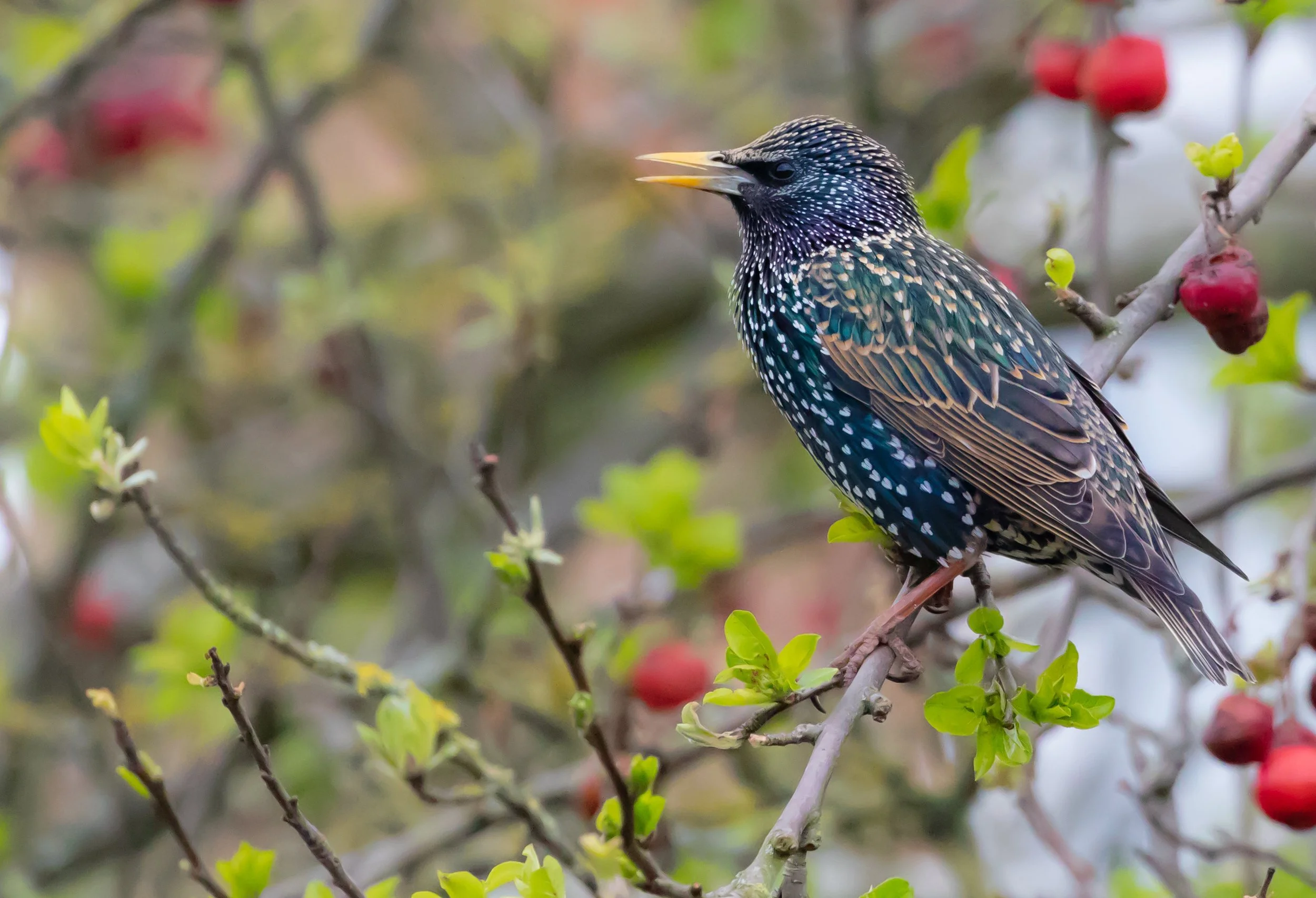
There are plenty of reported misunderstandings in which the punchline is provided by a starling.
They like to throw in other birds’ calls too, including those that we might not expect to hear from a suburban chimney.
During the day, many starlings go out to feed on pasture and grazing marsh. Here they sometimes pick up the sounds of wildfowl and wading birds, such as golden plover, wigeon or lapwing.
Helpfully, starlings do like to sit out high when they sing.
So whatever strange vocal brew they’ve concocted, there's usually a way of checking what's made the noise: look up.
Alongside the collared dove and the jackdaw, the starling is the bird most likely to be performing from a TV aerial, or the end of a roof gutter.
These days it is, of course, frowned upon in polite society to mention starlings without talking about murmuration, the visual spectacle for which they are famed.
In winter, starlings can gather in the air in their thousands (sometimes hundreds of thousands), creating extraordinary collective shapes that warp and twist, before they go into roost together.
Murmurations now tend to be associated with wilder places, or perhaps with the fringes of human settlements (such as seaside piers) but they were once a regular sight above the very centre of large cities too.
It's reported that the sound of a large murmuration in town could drown out the noise of traffic. This recording of a big group of starlings chattering away to each other pre-roost gives a taste of that.
But while still one of our more common birds, there are far fewer starlings in the UK than in the recent past.
More than half disappeared between 1995 and 2020, with the starkest declines in our woodlands, many of which no longer have starlings breeding in them at all. Declines have taken place across much of northern Europe.
Globally they have been faring better, having been introduced by humans to many parts of the world away from their native European and southwest Asian range. They are now a familiar garden bird - and to some an unwelcome visitor - in places as scattered as Argentina, Australia, South Africa, Mexico and Canada.